Just Digital · SEO/GEO case study · July 2026
How Justin Welsh lost 94% of his traffic to a Google core update
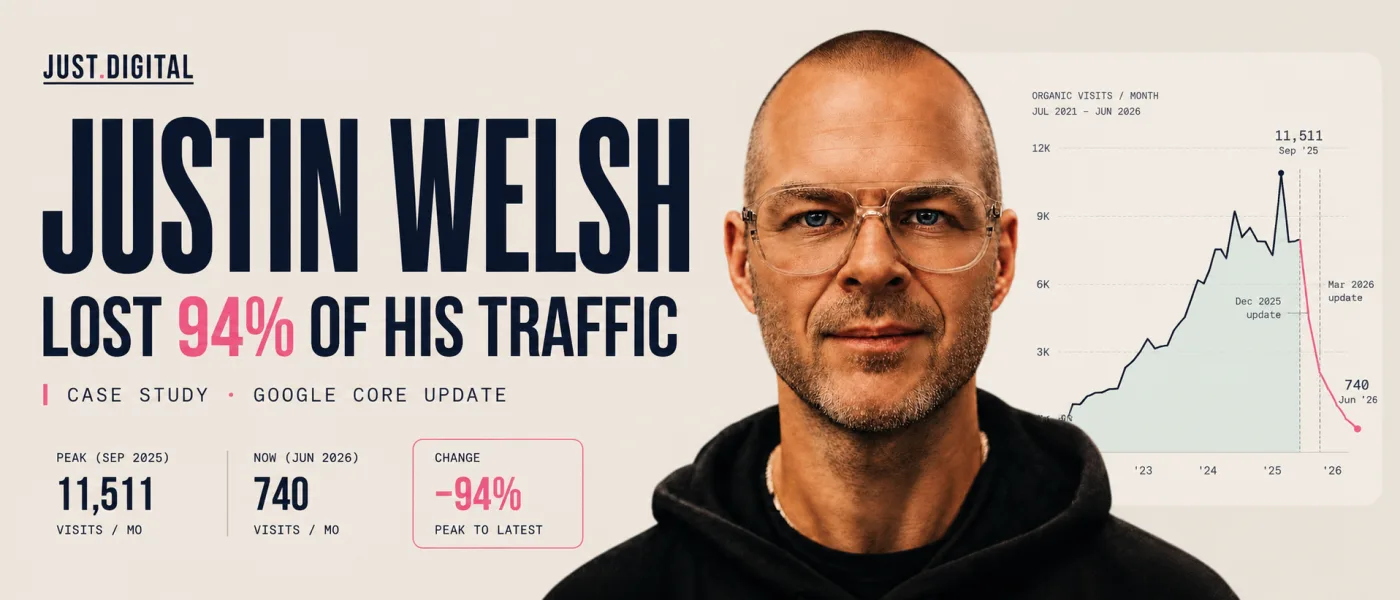
Justin Welsh grew his site's US organic search traffic around 480 times in four years, then lost roughly 94% of it in six months when Google's December 2025 and March 2026 core updates demoted his programmatic glossary. Rented traffic always gets recalled.
Every figure in this piece is US organic search, estimated by Semrush.
Key findings
What happened to justinwelsh.me? The short version
- Organic search traffic peaked at about 11,511 visits a month in September 2025 and fell to about 740 a month by June 2026, a drop of around 94%.
- The collapse began in January 2026 (8,685 down to 5,199, a 40% fall month on month) and fell every single month to 740 by June 2026.
- What got hit was a large programmatic glossary of /glossary/what-is-* definition pages, not the whole site.
- Ranking keywords peaked at 9,179 in January 2026, the same month traffic began collapsing. The pages stayed indexed but demoted, so this is an algorithmic demotion, not a penalty or a de-indexing.
- Referring domains held at about 2,571, so this was not a backlink-loss story.
- He deleted the glossary (every /glossary/* URL now 404s) and refocused on his 230,000-plus newsletter ($4.15M revenue in 2024).
| Metric | Peak (Sept 2025) | Now (Jun 2026) |
|---|---|---|
| Organic traffic (visits/mo) | 11,511 | 740 |
| Ranking keywords (top 100) | 8,177 | 4,219 |
Keyword peak was 9,179 in Jan 2026 (US); 8,177 is the Sept 2025 figure shown against the traffic peak.
The rise
How did justinwelsh.me grow traffic around 480 times?
From about 24 visits a month in mid-2021 to 11,511 a month in September 2025: roughly 480 times in about four years.
The engine was a programmatic glossary of near-identical /glossary/what-is-* definition pages targeting "what is X" queries. Ranking keywords climbed in lockstep with the page count, from 2,613 in January 2024 to 8,677 in December 2025.
It worked because definition queries were cheap to rank for at scale before the updates. This was a rational, well-executed play, not a shortcut nobody understood. Wayback confirms the glossary was live and archived on 22 April 2025, with captures spanning 4 March 2025 to 25 January 2026.
Representative pages: /glossary/what-is-market-diversification · /glossary/what-is-competitive-analysis · /glossary/what-is-content-monetization · /glossary/what-is-an-influencer · /glossary/what-is-market-saturation
The cliff
When did the traffic collapse?
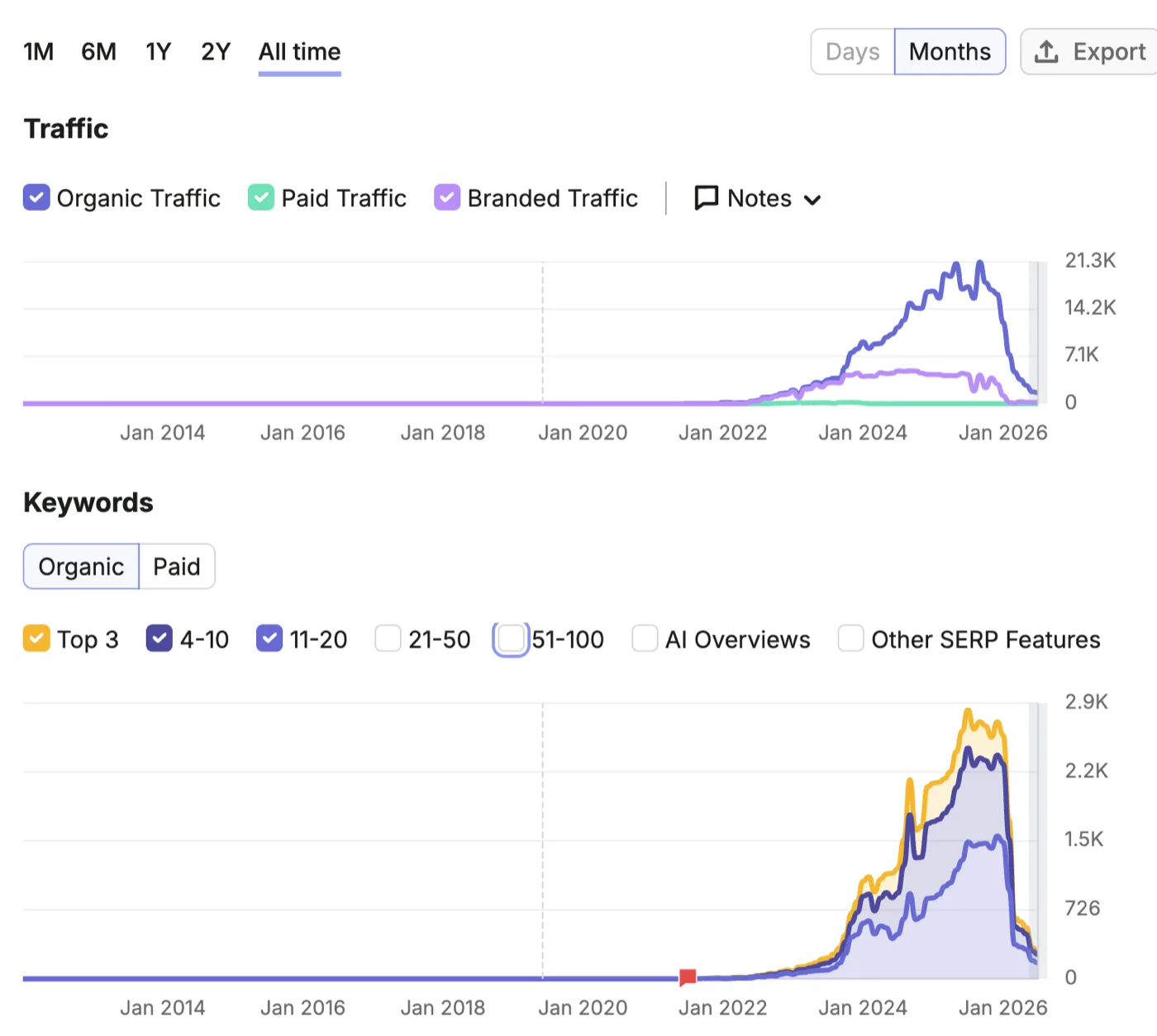
Through 2025 the site sat on a plateau of about 8,600 to 11,500 visits a month. The cliff begins in January 2026 (8,685 down to 5,199), the steepest single month at minus 40%. Traffic then falls every month: 5,199, then 3,199, 2,462, 1,738, 1,182, and 740 by June 2026. That is about a 91% drop across the six months from December 2025 to June 2026.
| Month | Visits |
|---|
The fingerprint
How do you know it was a demotion?
The ranking keyword count peaked at 9,179 in January 2026, the exact month traffic began collapsing. By June 2026 the site still ranked for 4,219 keywords, over half the peak, but had lost the positions that get clicks. Look at where those keywords sit: rankings in the top three positions fell from 190 in November 2025 to 10 by July 2026, while most of the glossary slid to positions 51 to 100, page six and beyond, where nobody clicks.
Keywords staying high while traffic craters is the fingerprint of an algorithmic demotion. Contrast the alternatives: a de-index or manual penalty sends the keyword count towards zero; a link loss shows up in referring domains. Neither happened here. The reader's takeaway: to classify any traffic drop, check keywords against traffic first.
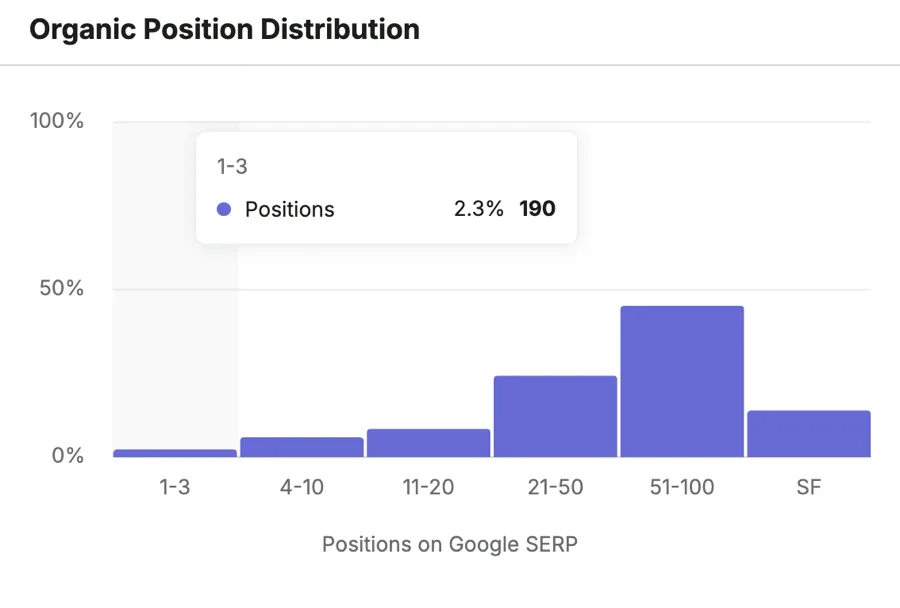
Nov 2025: 190 keywords in positions 1–3
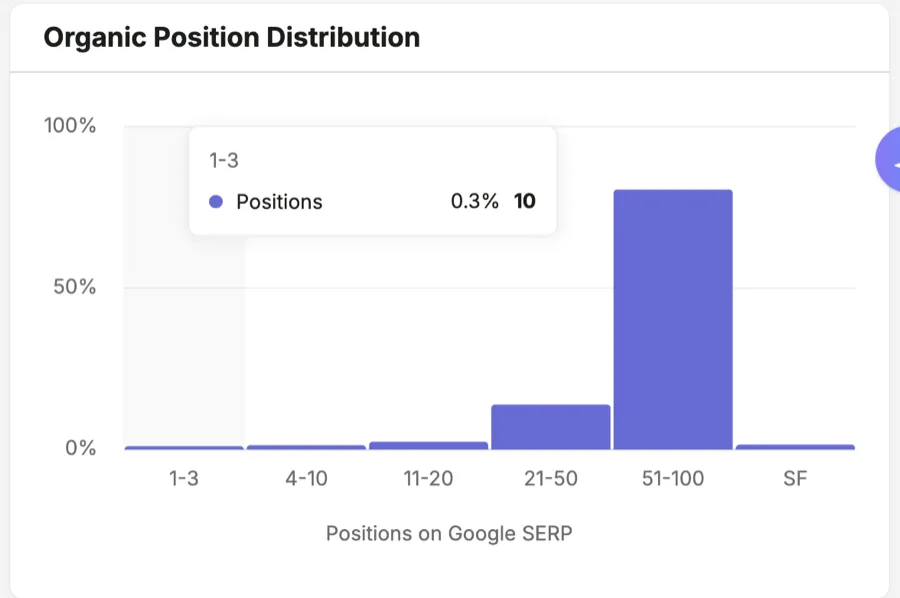
Jul 2026: 10 keywords in positions 1–3
| Month | Keywords (raw) | Keywords (index) | Traffic (raw) | Traffic (index) |
|---|
It wasn't the links
Did justinwelsh.me lose its backlinks? No
Referring domains rose and then held through the whole collapse, from about 1,609 in mid-2024 to about 2,571 in June 2026. Total backlinks peaked at about 18,994 in late 2025 and eased to 13,150, a symptom of removed pages rather than a cause. Authority Score drifted from 40 to 32, which follows lost pages and links rather than triggering the drop.
Links held while traffic fell. That places the cause in the content and the algorithm, not the backlink profile.
| Month | Ref domains (raw) | Ref domains (index) | Traffic (raw) | Traffic (index) |
|---|
The receipts
What did the pages look like, before and after?
The same URL, fourteen months apart. On the left, the archived live glossary page. On the right, today's 404.
Market Diversification
Market diversification refers to the strategy of expanding a company's product or service offerings into new markets or industries to reduce risk and increase potential for growth.
Source: Wayback Machine capture, 22 Apr 2025, web.archive.org/web/20250422202409/justinwelsh.me/glossary/what-is-market-diversification
That page doesn't exist (or it moved).
Source: live site, observed Jul 2026. Google still lists this URL; it now 404s.
Why Google did it
Why did Google demote the glossary?
Two core updates did it: the 11 December 2025 update (rollout to about 29 December) and the larger, more volatile March 2026 update. Both aimed at scaled content abuse.
Scaled content abuse is Google's term for producing many low-differentiation pages mainly to rank in search, regardless of who or what makes them. A single definition template repeated across thousands of "what is X" pages is the textbook example. The timing, plus the signature of keywords staying high while traffic collapsed, matches an algorithmic demotion aligned to these updates. That is a demotion, not a manual penalty, a distinction the FAQ reinforces.
This also lines up with Google's E-E-A-T framework (Experience, Expertise, Authoritativeness, Trust). A single template stamped out across thousands of pages rarely shows the first-hand experience E-E-A-T rewards, which is exactly the gap the scaled content abuse policy targets. E-E-A-T itself is not a ranking factor Google applies directly; it is the lens Google's own quality raters use to judge whether content like this deserves to rank at all.
Diagnostic signature
| Pattern | Keywords | Traffic | Verdict |
|---|---|---|---|
| Demotion | Stay high / rise | Falls | Lost clicking positions (this case) |
| De-index / penalty | Fall to near zero | Falls | Pages left the index |
| Decay | Drift down slowly | Drifts down | Rising competition / relevance loss |
| Growth | Rise | Rises | Winning (the same play in reverse) |
Update calendar
Sources: Search Engine Land core-updates guide, ppc.land December update report, SE Ranking March 2026 analysis, Digital Applied scaled-content-abuse guide.
The retreat
What did Justin Welsh do next?
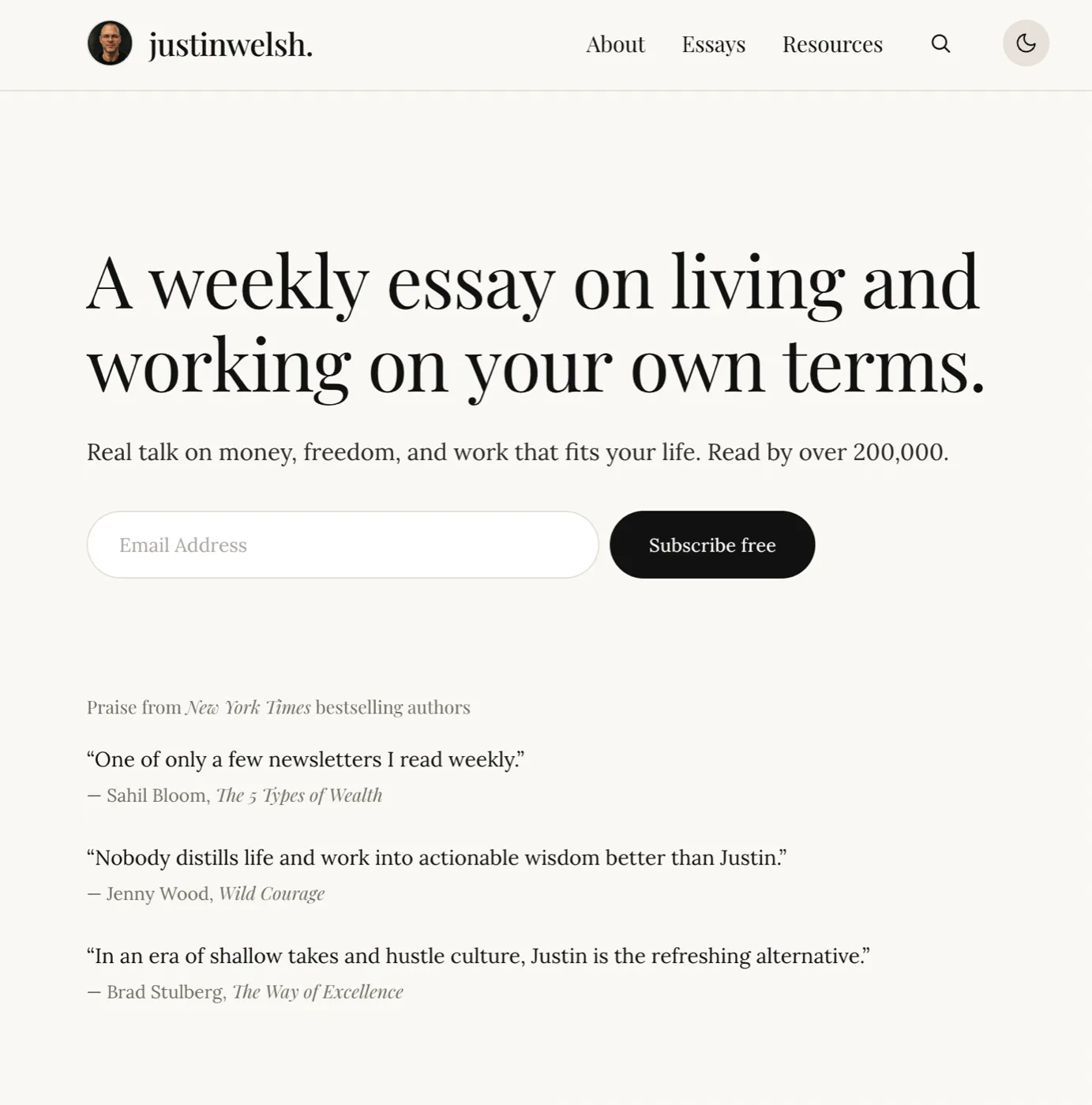
The glossary is fully removed. Every /glossary/* URL 404s today, though Google still lists them. He stopped feeding an asset Google had switched off. Site navigation was cut down too. This is a classic, sensible post-hit retreat, not panic, confirmed directly via the live site and the Wayback Machine.
The lesson
Owned audience beats rented traffic
The Saturday Solopreneur newsletter runs 230,000 to 250,000-plus subscribers, growing about 15,000 a month, and sits entirely off Google. Reported business figures: about $7M lifetime revenue, $4.15M in 2024; courses (LinkedIn OS, Content OS) at about $250 to $300; no employees. The glossary was a bolt-on Google could recall. The newsletter is the asset Google can't switch off. Brand terms still rank ("justin welsh" at #2, "justinwelsh" at #2, plus /about), so the business itself was never at risk.
- The SEO glossary
- Down about 94%
- Google-controlled
- Recalled in six months
- The newsletter audience
- $4.15M revenue in 2024
- Off Google entirely
- Barely flinched
When the traffic died, the pages hadn't left Google's index. They'd just lost the positions that get clicks.
At least not yet: Google still lists some of these URLs today, but the pages themselves are now deleted, so they will drop out of the index in time.
Welsh's business figures are reported, not exact. Sources: Growth In Reverse, The Tilt.
Dom's verdict
Focus on people, not the algorithm
My honest take: Justin Welsh fell for the trend. AI made it easy to spam the internet at scale, the same way I did back in 2012, before AI existed. I lost a €500,000 blog to a Google penalty that year. Spam content, spam links. Everything crashed overnight. I made money from it too, for a while. Then Google came for it.
That's the actual lesson here. Not "don't do programmatic SEO." Programmatic SEO isn't the mistake. The mistake is which terms you scale.
A glossary of "what is X" definitions is top-of-funnel and generic. Nobody remembers where they read a definition, and nobody buys because of one. Google eventually notices the same thing.
If you're going to scale content, scale content close to a buying decision. Bottom-of-funnel, buyer-centric terms. The kind of page someone reads right before they reach for a card, not the kind they forget five minutes later.
Here's what I'd actually do:
- Target bottom-funnel, buyer-centric terms, not generic top-of-funnel definitions. If a term doesn't sit close to a real buying decision, it's not worth scaling.
- Put a human in the loop before anything publishes. Real quality control, an actual E-E-A-T check, a pass against Google's own Quality Rater Guidelines. Scale without that system and you're just spamming faster than I did in 2012.
- Put an email capture on every page that earns you search traffic, with a clear call to action to join the list, like the one below. Google can switch off a ranking. It can't switch off a list.
Build for people, not the algorithm. I've been on both sides of this.
Ready to act on the bottom-funnel advice? The follow-up is live: our honest guide to conversion rate optimization tools, sorted by job, budget, and traffic level, with the $9 diagnosis-first stack we recommend before any subscription. And for the build-back-resilient version of this story, read 50 search optimization tips for 2026: rank without the thin-page pattern, survive the updates, then check the page converts. The keywords that should replace a glossary like this one are mapped in bottom of funnel keywords.
Dom, Just Digital
Get the next one
What actually gets people to buy
Case studies like this one. AI marketing that converts. SEO that actually works. No spam, no hype.
Unsubscribe anytime. Your email, nobody else's.
FAQ
Frequently asked questions
Its organic search traffic peaked at about 11,511 visits a month in September 2025, then fell to roughly 740 a month by June 2026, a drop of around 94%. The fall hit a large programmatic glossary of definition pages, not the whole site. Google's December 2025 and March 2026 core updates demoted that scaled content, and the owner then deleted the glossary.
No. This was an algorithmic demotion, not a manual penalty. A manual penalty is a human action reported in Search Console that can remove or bury a site; an algorithmic demotion happens when a core update reweights what ranks. Here the pages stayed indexed and kept ranking for thousands of keywords, they just fell out of the positions that get clicks.
It is Google's term for producing many low-differentiation pages mainly to rank in search, regardless of who or what makes them. A near-identical template repeated across thousands of "what is X" definition pages is the textbook example. Google's December 2025 and March 2026 core updates made scaled content abuse a primary target.
No. What got hit was undifferentiated programmatic content, thin definition pages that added little beyond a template. Programmatic pages that are genuinely useful and differentiated can still rank. The lesson is about quality and differentiation, not page count.
Look at keywords versus traffic. In a demotion the site keeps ranking for its keywords (justinwelsh.me still had 4,219 ranking keywords in June 2026) but loses the clicking positions, so traffic falls while the keyword count stays high. In a de-indexing or penalty the ranking keywords fall towards zero because the pages leave the index.
Build an audience you own. Justin Welsh's newsletter, at 230,000-plus subscribers and $4.15M of revenue in 2024, never depended on Google, so the update barely touched it. Treat search traffic as upside on top of an owned audience, not the foundation.
Yes, indirectly. E-E-A-T (Experience, Expertise, Authoritativeness, Trust) is the framework Google's quality raters use to judge content, not a direct ranking signal. A glossary of near-identical definition pages is a textbook example of content with no first-hand experience behind it, which is the same gap the scaled content abuse policy is built to catch. The core updates and the E-E-A-T guidance point at the same underlying problem from two different angles.
Methodology and data
How this analysis was built
This is first-party analysis using the Semrush US database, pulled July 2026: domain_rank_history, domain_organic (current and lost), domain_organic_unique, backlinks_overview and backlinks_historical. Google update dates come from the cited sources. The glossary lifecycle was confirmed via Wayback (22 April 2025) and a live check (July 2026).
Traffic and keyword figures are Semrush estimates. Justin Welsh's business figures are reported, not exact. Equivalent ad value (a Semrush "Organic Cost" proxy) peaked around $11,500 a month in September 2025 and is now about $2,400 a month, clearly an estimate.
Estimates caveat. All traffic, keyword and ad-value figures are Semrush estimates for the US database. Business revenue and subscriber figures are reported by third parties.
| Month | Traffic | Keywords | MoM traffic |
|---|---|---|---|
| Dec 2025 | 8,685 | 8,677 | n/a |
| Jan 2026 | 5,199 | 9,179 | −40% |
| Feb 2026 | 3,199 | 7,459 | −38% |
| Mar 2026 | 2,462 | 6,098 | −23% |
| Apr 2026 | 1,738 | 6,015 | −29% |
| May 2026 | 1,182 | 6,030 | −32% |
| Jun 2026 | 740 | 4,219 | −37% |
About the author