Case study · Childcare SaaS · September 2026
From #21 to gone to a page that scores 82. In one day.
A German childcare software company thought it had been kicked out of Google for its category keyword. It had not been kicked out. It had been out-built. Here is what we did about it in one working day, anonymised, every number real.
The call that started it
The founder sent one line: "It looks like we dropped out of the search results for our main keyword." One keyword, about 1,900 searches a month, the term his whole category is named after. He was right about the symptom and wrong about the cause. Nothing was broken. Four things had stacked up, and none of them were on his radar.
What the diagnosis found
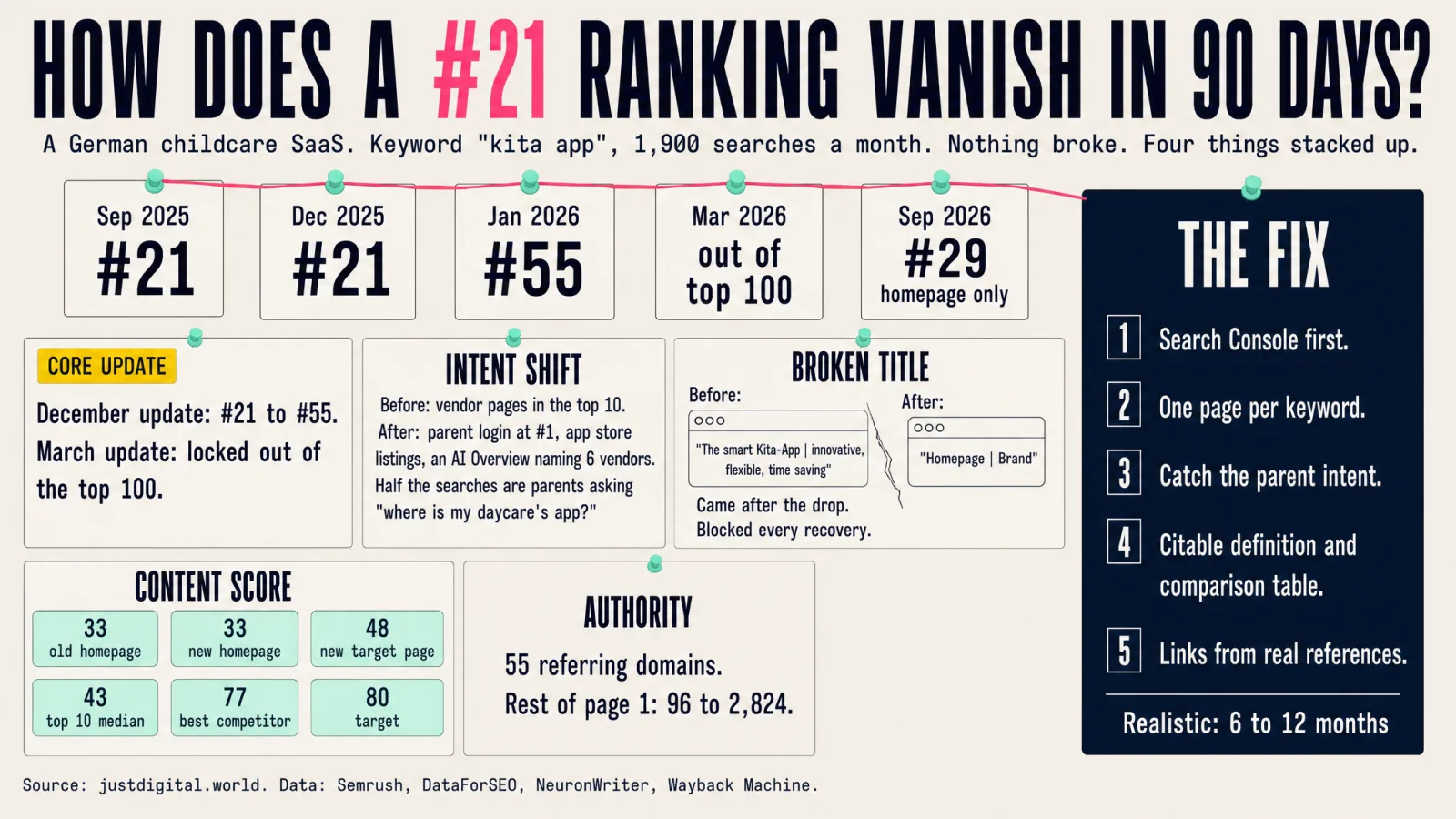
- The keyword was never on page one. Best ever: position 21, in September and December 2025.
- Two core updates and an intent shift. December 2025 took the page from 21 to 55. By March 2026 it was out of the top 100. The results page had switched from vendor sites to parent logins, app store listings and an AI Overview naming six vendors. Half the searches now come from parents looking for their own daycare's app.
- A broken title. Between March and April the homepage title lost the keyword and became "Homepage | Brand". It came after the drop, and it blocked every recovery until the relaunch in summer.
- Cannibalisation after the relaunch. The new homepage and the new category page carried the same title lead and the same H1 lead. Google showed the homepage at 29 and dropped the category page.
- Authority. 55 referring domains. The rest of page one: 96 to 2,824. The fewest of the whole page.
And the content score, the number nobody had looked at: the old homepage scored 33 in December, 33 after the relaunch, and the new category page 48. The top 10 median was 43. The best competitor: 77.
What we built instead of a blog post
A category keyword with a buying intent does not want an article. It wants a sales page that also earns the ranking. So the deliverable was a brief for a sales page, then the page itself. The brief ran the full research pipeline first: writing rules, jobs to be done, information gain against the live top 10, search intent, the buyer's own words from customer interviews, title and meta options, a section outline, external sources from ministries and institutes, fact infusion, calibration, banner placement, query fanouts, FAQ, internal links, an LLM description. Nineteen steps. Then a human read the brief and said yes. Only then did anyone write copy.
The page itself: a hero with three proof chips, a parent switch in the first screen (because half the visitors are parents), a citable definition, five daily scenes with real app screens, a price table with a calculator and every extra cost named, a data protection block with the five questions a data protection officer will ask, a three step rollout, a fit section for daycares, after school care and funding bodies, a comparison table, thirteen FAQs, a two step form and a sticky call to action. Full anatomy of the brief: What goes into a sales page brief?
The finding worth the whole day
The first draft scored 58. Same text, title and H1 spelled without the German hyphen, plus one word added to the title: 87. The scoring tool matches the query literally, and the correct German compound with a hyphen earns nothing in the title, H1 and H2 slots. Body copy keeps the correct spelling. Title and H1 do not. That one change was worth 29 points.
The second finding: the draft used the keyword 82 times. The suggested range was 5 to 14. The best competitor used it 23 times. We thinned it to about 50 including the FAQ. Over-optimisation costs points too.
Seven checks before anyone saw it
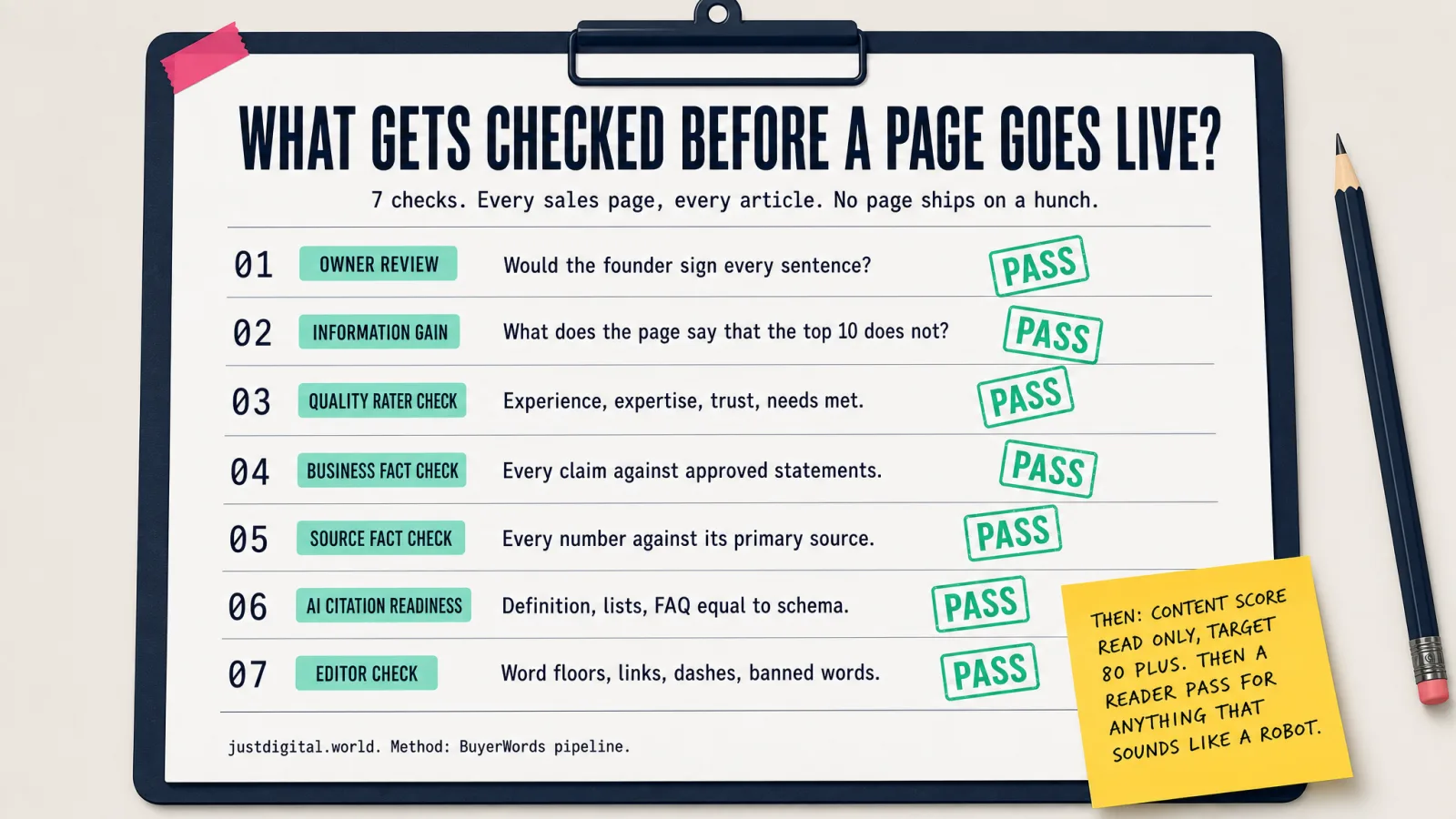
Seven reviewers, run in parallel, each with a fixed brief and a written report: owner review (would the founder sign every sentence), information gain against the top 10, quality rater check, business fact check against the approved statements, source fact check against the primary documents, AI citation readiness, and a mechanical editor check. They found 40 things. Among them:
- Three claims that came from a customer video and had been written as facts. Cut until the customer releases the quote.
- A study attributed to the wrong publisher. Corrected at the source.
- Two survey figures attributed to the wrong report. Moved to the right one.
- One sentence the founder would never put on his own site: "If something goes wrong, the director is in the newspaper, not the vendor." True in interviews. Wrong on a page a funding body will forward. Cut.
- Zero external links in the copy file. Ten sources were named, none linked. Fixed with inline links and a sources block.
Then a reader pass: 22 lines rewritten because they sounded like a term list, not like a person. "Check children in and out" became "sign children in and out". "Honest answers" became "two things up front". A line about "the longest serving colleague" was rewritten because it read as an age jab. After the fixes the score settled at 82, above the target of 80, with the best competitor at 77.
Where it stands
The page is live as a prototype with a feedback layer: the founder clicks any spot and leaves a pin, every pin lands with us. Six new visuals were rendered from a brand profile built from his site and checked in two rounds, one of them rejected and redone because the labels sat on the wrong step. The open items are his: the homepage title change that resolves the cannibalisation, Search Console access, two quotes waiting for release, and the real parent login URL.
What the page cannot do on its own is fix authority. 55 referring domains do not reach page one for a head keyword with an AI Overview. That is the next engagement: links from the institute listing, the reference municipalities, the press pieces, and the review platforms. Realistic timeline for the top three: six to twelve months.
What you can take from this
- Check the content score before you blame the algorithm. 33 was 33 before and after the relaunch. Content was not the trigger. It was the reason nothing recovered.
- One keyword, one page. Two pages with the same title lead cancel each other out.
- Test the title spelling before you write the body. A read only score check costs nothing and moved this page 29 points.
- Serve both intents. If half the searchers are parents, the page routes them in the first screen instead of losing them.
- QA is not proofreading. Seven checks with written reports found a wrong publisher, three unreleased quotes and a sentence that would have embarrassed the founder.
Want this done for your category page?
Message Dom on LinkedIn. Two lines about the page and the keyword are enough. You get the diagnosis first, then we decide together whether a page is the right fix.
Message Dom on LinkedInMethod: BuyerWords content brief pipeline, 28 steps. Data: Semrush, DataForSEO, NeuronWriter, Wayback Machine, the client's approved statements, a customer DNA study from founder and customer interviews. Client and competitors anonymised. Prepared by Just Digital, justdigital.world.